
Race Guide · Six Races Compared
Six Late-Summer Ultras, Six Very Different Reasons to Sign Up
A data-driven guide to what separates these races — and which one is actually right for you.
At DiscoverTrailRaces.com, we want you to discover the ultras that call to you, and we try to take care of the nerdy intel and details to get you to the start line. In the six weeks between late August and mid-September, six very different races are asking for your entry fee, your legs, and about 20 to 30 hours of time on feet. They tiptoe their schedules around UTMB week, with none falling on that last week of August that competes with UTMB, CCC, and ultra trail’s biggest yearly event.
What they all offer is not just contrast to UTMB, but quite unique experiences — six different countries, with different traditions, strengths, and race profiles, all clustering around the 100km distance. If you’re still looking for that late summer ultra, an alternative to CCC, a big week out with the family, take a close look.
The Numbers at a Glance
| Race | Distance | D+ | D+ / km | Avg uphill | % Flat | € / km | Entry status |
|---|---|---|---|---|---|---|---|
| Sörmlands Trail Run | 100 km | 1,300m | 13 m/km | 5.3% | 58% | €1.57 | Open |
| GRP Tour des Cirques | 124.8 km | ~7,000m | 56 m/km | 13.4% | 12% | €1.40 | Lottery closed |
| Ortles Haute Route | 121.83 km | 9,000m | 74 m/km | 15.3% | 12% | €1.40 | Open |
| SwissPeaks Trail 101 | 101 km | ~6,000m | 59 m/km | 15.1% | 13% | €2.04 | Open |
| Mayrhofen Ultraks Z101 | 101 km | 7,600m | 75 m/km | 15.4% | 14% | €2.13 | Sold out |
| Trail Valle de Tena Ultra | 80.15 km | 6,820m | 85 m/km | 18.7% | 8% | €1.50 | Open |
One of them has an average uphill gradient of 19%. Another barely climbs at all and feeds you at local restaurants along the way. One is being run for the first time ever; one has cancelled mid-race in the snow. One allows exactly 101 starters. One requires a qualifying race on your résumé before you can even apply, and has just a few spots left.
Here’s how to figure out which one you should actually be entering.
Sörmlands Trail Run — 100km, Sweden
Nyköpingshus Castle → Baltic coast · September 12, 2026 · 5th edition · RD: Billy White
Flattest on this list · Most accessible entry point| Metric | Sörmlands 100km |
|---|---|
| Distance | 100 km (point-to-point) |
| Elevation gain | 1,300m |
| Gain per km | 13 m/km — flattest on this list |
| Avg uphill gradient | 5.3% |
| % flat | 58% — flattest on this list |
| Biggest single climb | 43m (not a typo) |
| Date | September 12, 2026 |
| Start | Nyköpingshus Castle, Sörmland, Sweden |
| Nearest airport | Stockholm Skavsta (NYO) — 13 min |
| Entry fee | €1.57/km · Open |
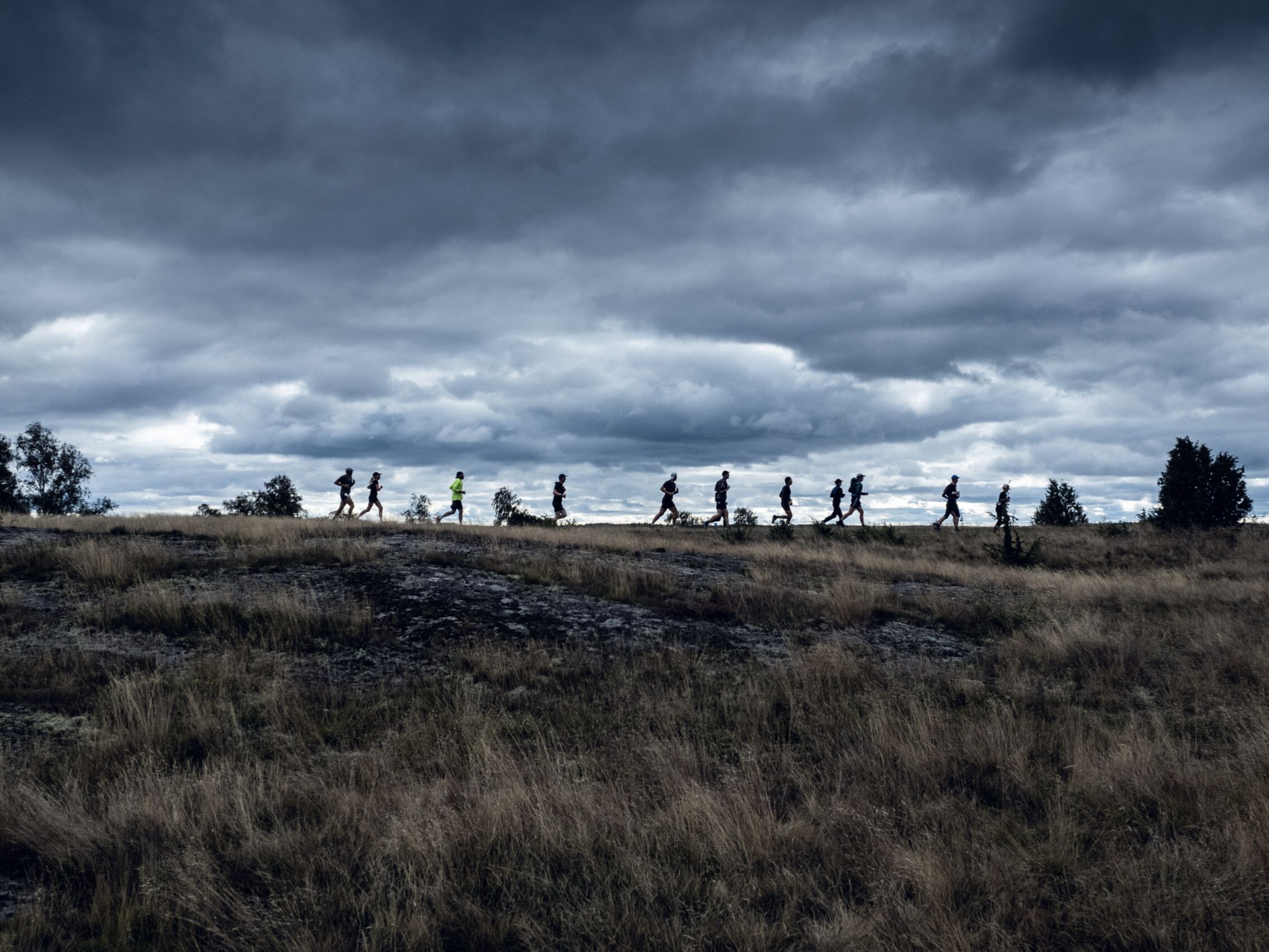
The biggest climb on the Sörmlands Trail Run 100km gains 43 metres. That’s not a typo. The course is 58% flat — the flattest 100km on this list by a wide margin — and it runs point-to-point from a 17th-century castle through Sörmland’s rolling forest and farmland to the coast. But Sörmlands is far more than the flattest race of this bunch.
The Sörmlands race oozes old-school trail running ethos, with a kick — race director Billy White is not just a distance runner himself but an author and chef. So Sörmlands does things a bit differently: aid stations are located at some of the region’s most well-regarded local restaurants and food producers. Driven by his ultra-running background in the UK, White says he wants the event to have a "hang outside with a beer afterwards" energy.
Sit down and talk to White for a while, and you’ll see that the motivation as race director is not to make money as much as to create a cultural event. He and his teams are solving questions like how to produce “1,000 portions of pancakes cooked in the middle of the forest.” Entry costs are kept deliberately low — the race offers highly affordable insurance terms for participants, a contrast to some events that bury those costs in the entry fee.
The course itself, while flat, can be deceptive. The second half ventures from rolling gravel roads onto highly technical single-track that will make you scrutinize your shoe choice. White says the last 15km is the most technically demanding, saving the hardest bits for last. For runners getting into trail who want to test themselves at 100km, this feels like a natural fit. The finish line in past editions has included a sauna, a handmade wooden medal, locally sourced hot food, and an invitation to jump into the nearby Baltic.
At €1.57/km and just 13 minutes from Stockholm Skavsta Airport, it’s one of the most accessible and affordable 100kms in Scandinavia. The 2026 race on September 12 is the fifth edition, and it grows every year.
First-time 100km runners, road runners doing a trail training block, runners who care as much about the experience around the race as the race itself, and anyone looking for a late-season adventure with minimal faff.
SwissPeaks Trail 101km, Switzerland
Villars-sur-Ollon → Lake Geneva · September 3, 2026 · Night start 20:00 · Founded 2017
Night start · Week after UTMB| Metric | SwissPeaks 101km |
|---|---|
| Distance | 101 km (point-to-point) |
| Elevation gain | ~6,000m |
| Gain per km | ~59 m/km |
| Avg uphill gradient | 15.1% |
| % flat | 13% |
| Start time | 20:00 Wednesday — night start |
| First climb avg gradient | 16.3% (to ~2,500m) |
| First descent | 958m drop / 6.36km / −15.1% avg |
| Date | September 3, 2026 |
| Start | Villars-sur-Ollon, Valais, Switzerland |
| Nearest transport | Geneva (GVA) — 2 hours by train |
| Entry fee | €2.04/km (CHF 189+) · Open |
| Finishers (2025) | 298 |
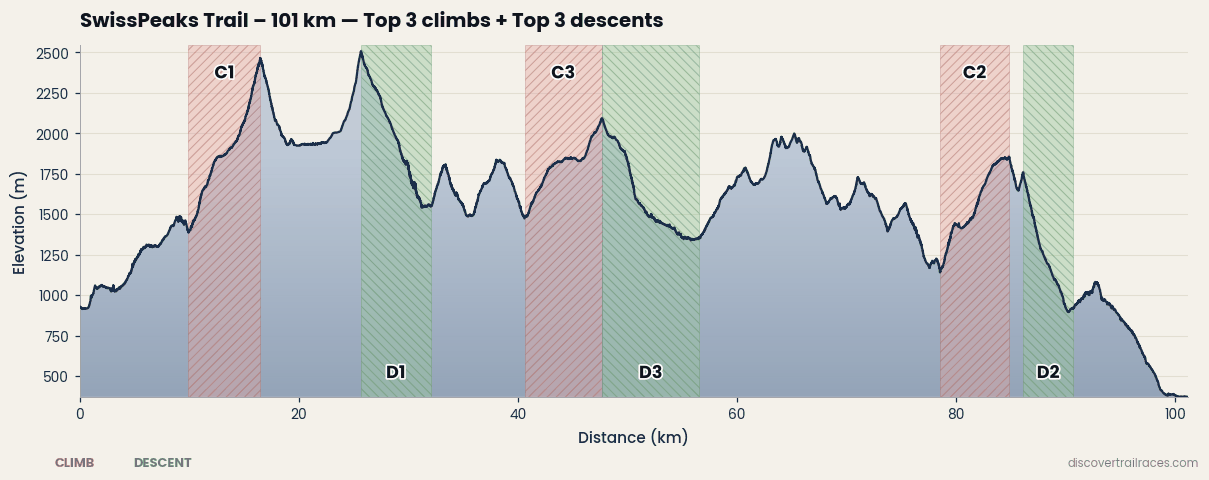
SwissPeaks Trail runs the week after UTMB. That’s not accidental — the race finishes on the shores of Lake Geneva and the Valais is directly accessible for anyone already in the Chamonix region. Some runners visit UTMB week to soak in the environment, cheer on friends, go on a hike or two while they taper, then make their way to the SwissPeaks start. A slightly different, slightly crazier contingent treats the two events as back-to-back.
The 101km starts at 20:00 — perhaps the most unconventional characteristic of the race. During a late summer event, you spend the first stretch of the race on technical high-alpine terrain in total darkness. The fastest runners finish around 10 AM the next morning, meaning the majority of the race was run in the dark. Midpack runners will push well into Friday. If you’ve been thinking about winter racing, consider this a preview.
The course crosses the Dents du Midi massif — the jagged multi-peaked ridge visible from almost anywhere in the Valais — before descending to Lake Geneva. It starts with a climb to those visible peaks, reaching roughly 2,500m. That first climb averages 16.3% gradient, and everyone faces the first descent in the dark: 958m of drop over 6.36km at −15.1% average. Watch your steps. Aid stations range from simple resupply points to full lifebases with hot meals, showers, beds, and — at least in past editions — chocolate fondue.
Perhaps the greatest draw for some runners is what SwissPeaks sits alongside. The race’s bigger sibling — the 643km, 43,800m D+ Odyssey — starts August 25. A friend might be out there. Or the longer distance starts to call you, and the 101 is a strong tune-up. At €2.04/km it’s the second most expensive race on this list, and access requires a two-hour train ride from Geneva. But 298 runners finished in 2025, the race has been running since 2017, and spots remain for 2026.
Alpine runners looking for a night race. Runners soaking in trail season in Switzerland in late summer. Runners looking for strong infrastructure and the option to string something together around UTMB week.
Grand Raid des Pyrénées Tour des Cirques — 124.8km, France
Piau-Engaly, Hautes-Pyrénées · August 21, 2026 · 41-hour cutoff
Qualifier required · Lottery closed for 2026| Metric | GRP Tour des Cirques 124.8km |
|---|---|
| Distance | 124.8 km |
| Elevation gain | ~7,000m |
| Gain per km | 56 m/km |
| Avg uphill gradient | 13.4% |
| % flat | 12% |
| Biggest descent | 1,588m / 11.34km (from km 13.74) |
| Avg descent gradient | −14.1% · 46% of course is downhill |
| Cutoff | 41 hours |
| Date | August 21, 2026 |
| Start | Piau-Engaly, Hautes-Pyrénées, France |
| Entry fee | €1.40/km · Qualifier required |
| 2026 registration | Lottery closed January 2026 |
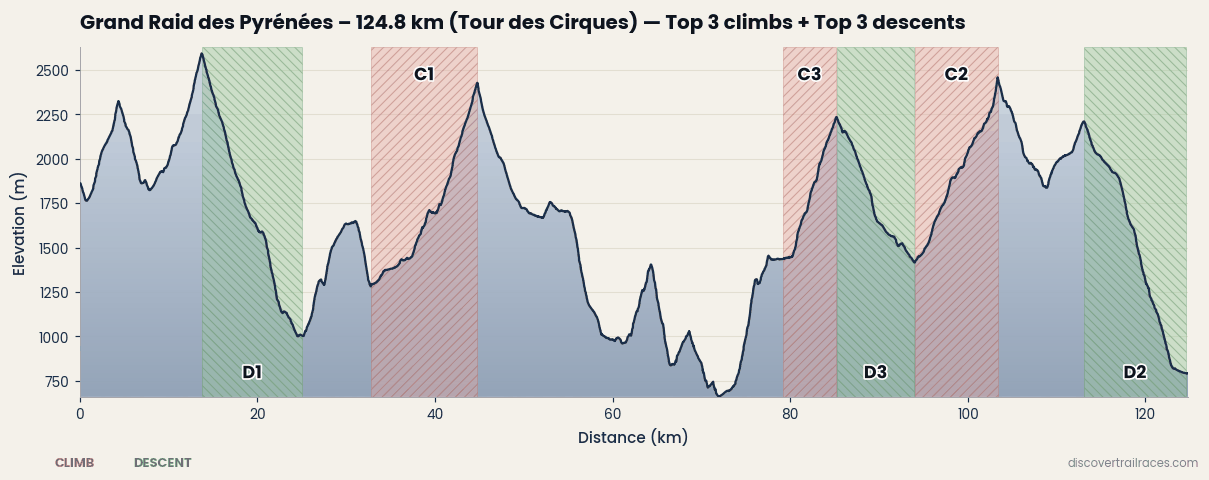
This one requires a qualifying race before you can even enter the lottery. And the lottery itself sold out in January 2026.
The Tour des Cirques lives up to that difficulty of access. It’s 124.8km with around 7,000m of gain, starting from the ski station at Piau-Engaly in the Hautes-Pyrénées before linking the cirques — the glacially carved amphitheatres that define this part of the mountains. The route passes through the Néouvielle natural reserve at 2,000m+, with glacial lakes and narrow trails on loose rock at altitude, which race coverage consistently describes as both the most technically demanding and most visually memorable section.
The course data tells a specific story about what kind of race this is. The average descent gradient is −14.1%, and 46% of the course is downhill. The single biggest descent starts at km 13.74, runs 11.34km, and drops 1,588m — one of the largest single descents in the DTR dataset at this distance. Training for that kind of eccentric force is hard to replicate, and it might catch runners who focus only on climb preparation. There is no easing in: you descend hard, immediately.
At €1.40/km and with a 41-hour time limit, the race is accessible by price if not by qualification. Getting in requires planning a year ahead for the lottery window. Interestingly, the Tour des Cirques’ bigger sibling — the 160km version — remains open for 2026 registration.
Experienced alpine runners with qualifying race credentials who want a Pyrenean grand tour and are prepared for sustained technical descending from kilometre 14 onwards. You can’t enter this one on a whim — that’s partly the point.
Mayrhofen Ultraks Z101 — 101km, Austria
Mayrhofen, Zillertal · September 4, 2026 · 101 starters maximum · GPS only
Sold out 2026 · No waitlist · GPS-only navigation| Metric | Mayrhofen Z101 |
|---|---|
| Distance | 101 km |
| Elevation gain | 7,600m |
| Gain per km | 75 m/km |
| Avg uphill gradient | 15.4% |
| % flat | 14% |
| 20%+ gradient km | 13.4 km |
| Final descent | 2,134m / 10.68km (valley return) |
| Field size | 101 starters (maximum) |
| Navigation | GPS only — no course marking |
| Date | September 4, 2026 |
| Start | Mayrhofen, Zillertal, Austria |
| Entry fee | €2.13/km — most expensive on this list |
| 2026 entry status | Sold out · No waitlist |
| Qualification | Previous ultra of 80km+ required |
| Estimated finishers (2024) | ~32 (ITRA data) |
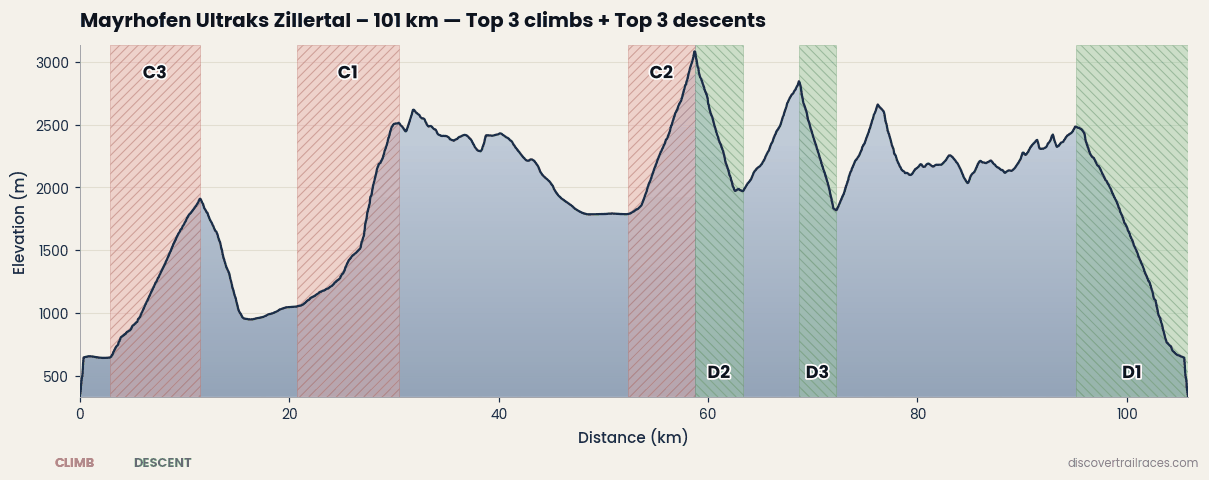
It’s called Z101 because only 101 people are allowed to start. That field is already sold out for 2026, with no waiting list. For those who classify themselves as serious sufferers, this is one to track for future years.
The 2025 edition was cancelled mid-race at roughly km 35–40 when snow conditions deteriorated beyond safe racing standards. The previous reroute — away from the highest point, Schönbichler Horn at 3,123m — had already happened before the start due to snow already present on the course. September in the Zillertal high alpine can do this to you.
The GPX data is relentless: 7,600m of gain over 101km, a distance-weighted average uphill gradient of 15.4%, and 13.4km sitting in the 20%+ steepness band. The finish is not a gentle roll into Mayrhofen — it looks more like falling off a table. The final descent drops 2,134m over 10.68km, one of the longest descents in all of Europe, from the high alpine back to the valley floor.
Navigation is entirely self-supported via GPS. There are no trail markers. The route crosses the Austrian-Italian border at Pfitscher Joch and passes through the Siebenschneidenweg — a traverse of seven consecutive ridges that is not, by any interpretation, runnable. Qualification requires proof of a previous ultra of at least 80km. At €2.13/km it’s the most expensive race on this list — and also the smallest. You’ll feel like you’re on the podium just for finishing.
Experienced technical mountain runners who want a race with very few starters, self-navigation demands, genuine attrition, and zero softening of the alpine experience. Sold out for 2026 — this is a race worth tracking for future editions.
Ortles Haute Route — 121.83km, Italy
Bormio, Stelvio National Park · September 11, 2026 · Inaugural edition · RD: Marco De Gasperi
Inaugural 2026 · No results history — a clean sheet| Metric | Ortles Haute Route 121.83km |
|---|---|
| Distance | 121.83 km |
| Elevation gain | 9,000m |
| Gain per km | 74 m/km |
| Avg uphill gradient | 15.3% |
| % flat | 12% |
| 20%+ gradient km | 14.85 km |
| Biggest climb | 1,714m / 15.15km (at km 73 · 11.3% avg) |
| High passes above 3,000m | 3 (Passo Zebrù 3,005m · Rifugio Casati 3,269m · Passo del Madriccio 3,123m) |
| Date | September 11, 2026 |
| Start | Bormio, Stelvio National Park, Italy |
| Nearest airport | Milan MXP/LIN — 3+ hours (flagged FAR) |
| Entry fee | €1.40/km · Open (not sold out) |
| Edition | Inaugural — September 2026 |
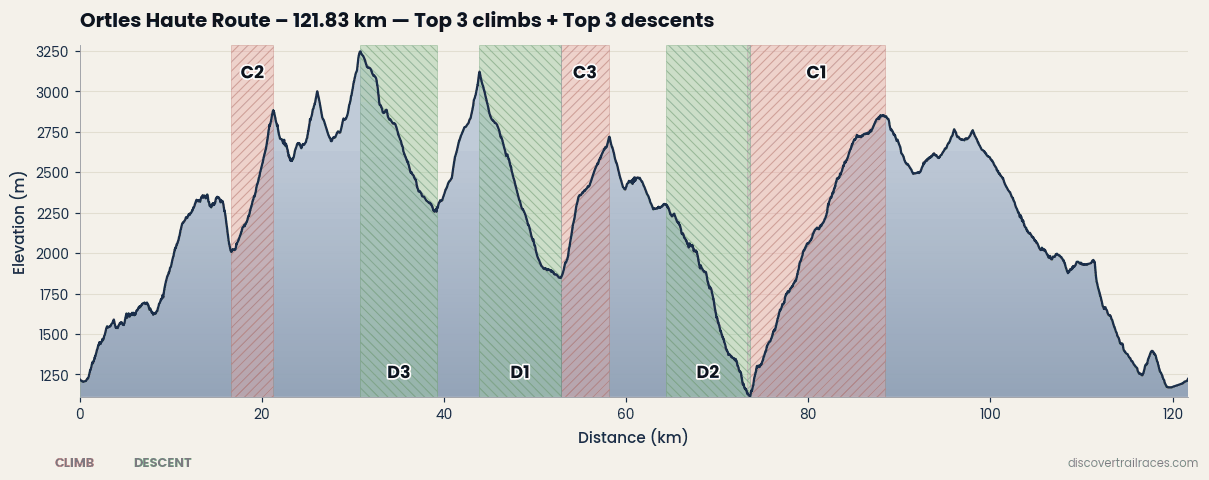
Nobody has finished this race. Not because it’s been cancelled — because it hasn’t happened yet. The Ortles Haute Route’s inaugural edition runs September 11, 2026, and it was designed by Marco De Gasperi, a six-time mountain running world champion, on terrain in his backyard where he grew up running.
The route connects Valtellina and Alto Adige entirely within Stelvio National Park, crossing three passes above 3,000m: Passo Zebrù (3,005m), Rifugio Casati (3,269m), and Passo del Madriccio (3,123m). The biggest climb arrives at km 73 and runs 15.15km with 1,714m of gain — a sustained 11.3% average, late in the race, after you’ve already accumulated well over 5,000m of ascent.
For those drawn by the idea of running an inaugural edition, there’s genuine curiosity here. As De Gasperi was still racing, he said: “Any race is potentially risky, and I always get a little scared when I put myself in the shoes of the organizers of the most demanding and technical races, like the Kima, or long-distance races like the Tor des Géants.” The gradient profile is uncompromising: 14.85km sits above 20% gradient — the steepest band, where most athletes are scrambling or using their hands. De Gasperi’s love for skyrunning leaves its mark on every kilometre.
Registration opened February 2026 and is not sold out at €1.40/km. Getting to Bormio requires effort — it’s the most remote start on this list, flagged as FAR with a 3+ hour drive from Milan airports — but the upside is arriving in one of Italy’s great mountain resort towns.
Mountain runners drawn to inaugural races and clean results sheets, with strong technical skills and no need for historical benchmarks to set expectations. The uncertainty is part of the appeal.
Trail Valle de Tena Ultra — 80.15km, Spain
Panticosa, Aragon (Pyrenees) · September 5, 2026 · 5:00 AM start · 11th edition
Steepest race on this list · 85m/km · 18.7% avg uphill| Metric | Valle de Tena Ultra 80.15km |
|---|---|
| Distance | 80.15 km |
| Elevation gain | 6,820m |
| Gain per km | 85 m/km — steepest on this list |
| Avg uphill gradient | 18.7% — steepest on this list |
| % flat | 7.8% — least flat on this list |
| Opening climb | 1,367m / 10.53km (from km 0.48) |
| Biggest climb (Garmo Negro) | 1,374m / 5.94km / 23.1% avg · max 3,064m |
| Cutoff | 25 hours |
| Date | September 5, 2026 · 5:00 AM start |
| Start | Plaza La Iglesia, Panticosa, Aragon, Spain |
| Nearest airports | Zaragoza (ZAZ) or Bilbao (BIO) — 2h drive |
| Entry fee | €1.50/km (€120–130) · OWAKA GPS included · Open |
| Course record (men) | 13:31:49 · Adrián Garcia (2025) |
| Course record prize | €1,000 |
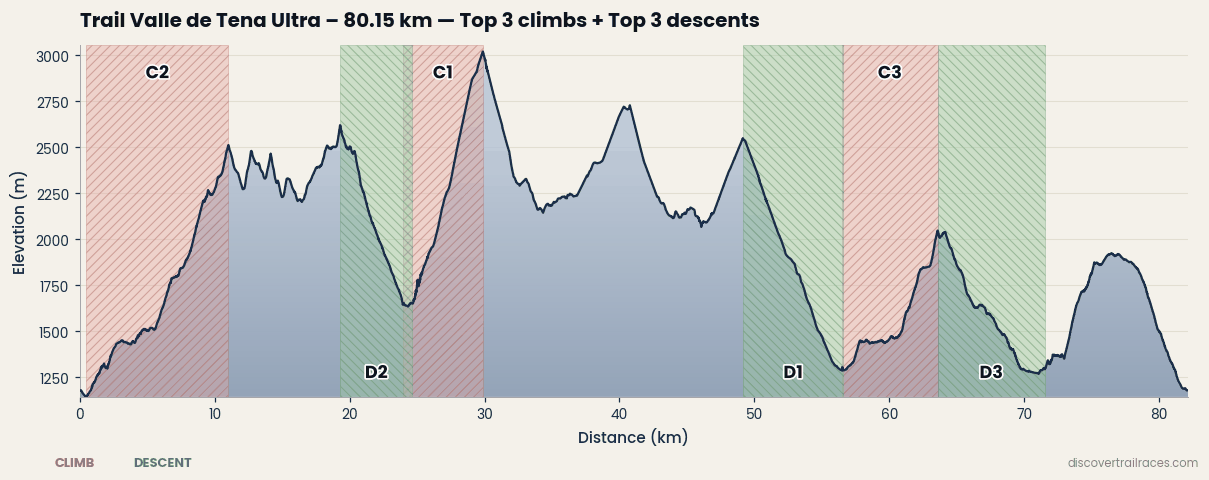
The numbers on the Valle de Tena Ultra are outliers even in this company. At 85m/km of elevation gain, it has more vertical per kilometre than any other race on this list — more than the Mayrhofen Z101, more than the Ortles Haute Route. Only 7.8% of the course is flat. The distance-weighted average uphill gradient is 18.7%.
At km 0.48, before you’ve barely warmed up, the opening grind begins — a 10.53km opener climbing 1,367m of gain. The biggest climb starts at km 24, gains 1,374m over just 5.94km at an average gradient of 23.1%, and peaks at Garmo Negro (3,064m). That 23% average means this section isn’t just steep — it’s hands-on-knees, possibly four-point scrambling terrain for most runners. The race is internally called the “8K” — shorthand for approximately 8,000m of D+, not 8 kilometres.
One 2018 runner described training for it as preparing by hiking rather than running — “se prepara pateando, no corriendo” — and noted that strict intermediate cutoffs punish anyone who doesn’t move efficiently on the terrain, not just on the ascent. Strict cutoffs at key waypoints mean that moving slowly through the technical sections costs you the race, not just time.
And for those who take on the challenge: this is the shortest race on this list. The race starts at 5:00 AM from the village plaza in Panticosa, and it’s a faster race despite the steep altitude than the Mayrhofen — the toll of Austrian Alps temperatures is gone, and although the course reaches 3,000m in the Pyrenees, the men’s course record stands at 13:31:49, set by Adrián Garcia in 2025. For those who want to channel their inner Remi Bonnet, a €1,000 prize is offered to anyone who breaks it.
Runners specifically hunting the hardest vertical-per-km ratio they can find in a sub-100km race, or alpine specialists who want a raw, non-corporate Pyrenean event in a small Aragonese village with no fuss and a lot of climb.
Pick Your Race
None of these races is interchangeable with another. Here’s the honest shortlist.
The D+/km difference between Sörmlands and Valle de Tena isn’t a detail — it’s a completely different athletic event. 85m/km versus 13m/km. A 23% average gradient on the biggest climb versus a 43-metre biggest climb. Get honest about which one you’re actually training for, not just which one sounds best in September.
Four of the six are still open. GRP is closed and Mayrhofen is sold out. If the GRP profile appeals to you, the 160km version still has spots. If Mayrhofen is the race you want, set a reminder for January 2027 when the next edition opens — and start logging your qualifier now.
All gradient and elevation figures sourced from DiscoverTrailRaces GPX data (Airtable Distances table, queried 2026). Entry fees, dates, and race details from official race websites and the DTR database. The GRP Tour des Cirques 2026 registration closed in January 2026; the 160km version remains open.
Sources
- DiscoverTrailRaces Airtable — Distances, Entry Fees, Race Events tables — queried 2026
- [Official] Sörmlands Trail Run — sormlands100.com
- [Feature] iRunFar — “Under the Radar Races: Sörmlands 100 Trail Festival” — irunfar.com — August 2024
- [Official] Grand Raid des Pyrénées — grandraidpyrenees.com
- [Official] Ortles Haute Route — ortleshauteroute.it
- [Feature] corsainmontagna.it — “Ortles Haute Route Trail 2026” — February 2026
- [Official] SwissPeaks Trail — swisspeaks.ch
- [Official] Mayrhofen Ultraks Z101 — mayrhofen.ultraks.com
- [Official] Trail Valle de Tena Ultra — trailvalledetena.com