ITALIA · Veneto
Trans d'Havet Ultra
Distancia
42 km
Fecha
July 25, 2026
Precio de inscripción
30 EUR
€ / km
€0.71
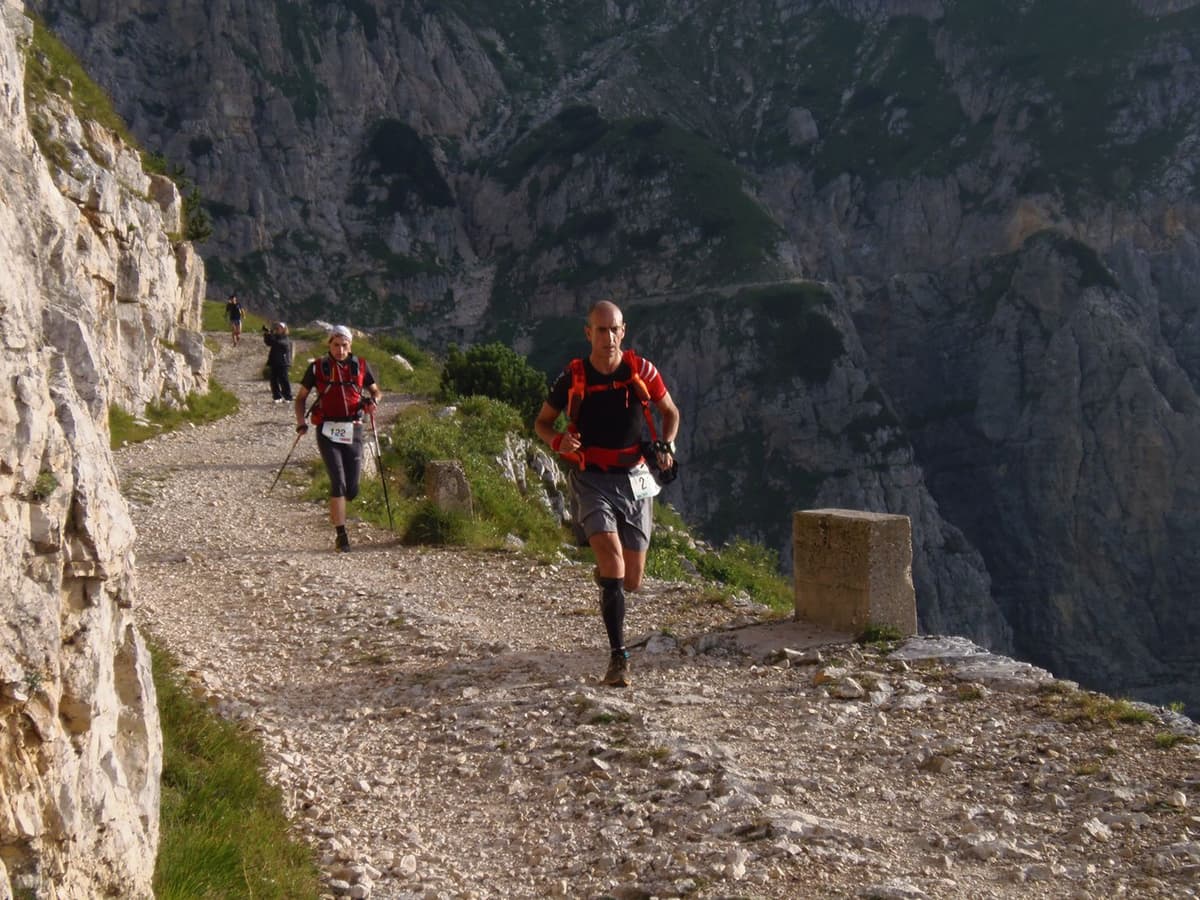
An Italian sleeper - night running and big vert in an overlooked local race in the ¨small¨ Dolomites
Elevación y Terreno
Metros totales
2700m
D+/KM
64.29m/km
Como referencia, el circuito Tor des Géants de 330 km tiene 73 D+/km.
Pendiente media de subida
16.6%
Pendiente media de bajada
-17.0%
Distribución del gradiente de subida
Perfil de ruta
Analysed 2026-05-02Desglose del terreno
Terreno
Ascensos
Principales ascensos
7.5 km · 1045 m gain
starts km 0 · avg 13.9% · max 49.6%
3.7 km · 577 m gain
starts km 8 · avg 15.8% · max 75.7%
2.3 km · 236 m gain
starts km 12 · avg 10.3% · max 72.3%
Principales descensos
12.4 km · 1369 m drop
starts km 29 · avg -11.1% · max -53.6%
2.5 km · 440 m drop
starts km 14 · avg -17.9% · max -53.1%
3.4 km · 285 m drop
starts km 20 · avg -8.0% · max -44.4%
Opening Climb at km 0.18: 1,045m Rise in 7.5km Before the Legs Are Warm
Q: What is the Trans d'Havet Ultra 42km? A: The Trans d'Havet Ultra 42km -- officially the TDH Recoaro Marathon 42K -- is a point-to-point mountain race from Recoaro Terme to Valdagno through the Piccole Dolomiti (Small Dolomites) of Veneto, Italy. The course covers 42km with 2,700m D+ (64.3 m/km), one of the highest gradient densities in the European ultra database at this distance. Distance-weighted average uphill gradient is 16.56% (UPPER tier, 15%+); only 11.8% of the course is flat. The race is the shorter companion to the flagship Trans d'Havet Ultra 80km and is in its 15th edition in 2026. Race date: Saturday 25 July 2026. Entry fee: EUR 60. ITRA-listed. Venice (VCE) is approximately 67 minutes away by car.
20%+ Gradient Band Is the Largest on the Course -- Steeper Than Any Other Race in the Batch
Q: How hard is the Trans d'Havet Ultra 42km? A: Extremely hard relative to its distance. The course has 2,700m D+ (64.3 m/km) -- the second-highest gradient density in this processing batch after Pirin Ultra 68km (64.7 m/km). The distance-weighted average uphill gradient of 16.56% is UPPER tier (15%+) and the steepest DW average in the batch. The 20%+ gradient band (5.49km) is the single largest uphill band on the course -- meaning most climbing is done at above 20% gradient. Only 11.8% of the course is flat -- the lowest flat proportion in the batch. The opening climb begins at km 0.18 (no warm-up) and rises 1,045m in 7.5km. The race ends with a 12.39km descent dropping 1,369m (-11.05% average). The 2024 edition included lightning storms. Official rules warn of cold, wind, rain, and snow at altitude even in July.
Descent #1: 12.39km, -1,369m -- The Final 14km Is One Enormous Drop into Valdagno
Q: What is the difference between the Trans d'Havet 42km and the 80km? A: Both distances finish in Valdagno and traverse the Piccole Dolomiti, but they start from different towns: the 42km starts from Recoaro Terme; the 80km starts from Piovene Rocchette. Both carry comparable gradient density -- the 80km has approximately 68 m/km D+ vs the 42km's 64.3 m/km -- confirming the 42km is not a flatter or easier alternative route but a distinct line through the same technical terrain. The 80km starts at midnight (night race); the 42km starts on Saturday morning (exact time not confirmed; check transdhavet.it). The 42km is ITRA-listed as TDH Recoaro Marathon 42K. Both distances are part of the same event weekend and share the Valdagno finish.
Lightning Storms in 2024 -- July Weather in the Piccole Dolomiti Is Never Guaranteed
Q: What are the weather conditions at the Trans d'Havet Ultra 42km? A: July in the Piccole Dolomiti is warm in the valley (25-30 C in Recoaro Terme and Valdagno) but significantly cooler at altitude. Afternoon thunderstorms are a serious risk: the 2024 edition was affected by lightning storms during the race. The official race rules (transdhavet.it/en/regolamento) explicitly warn that cold, wind, rain, and snow are possible at altitude even in summer. The 42km runs in daytime (unlike the 80km midnight start), so runners face the afternoon storm window. Waterproof and insulating layers should be carried regardless of morning forecast. The mandatory kit list [check official rules at Stage 5] likely includes waterproof jacket as a minimum; confirm before race day.
Archivos de carrera
Logística
Aeropuerto más cercano
Venice (VCE) / Verona (VRN)
Notas
Start: ~1–2.5 hrs by car to Piovene Rocchette and return from Valdagno / Public transport: trains to Vicenza/Schio then taxi / Accommodation: good in Vicenza area; limited in small towns